Audio Sample
Mary Shelley
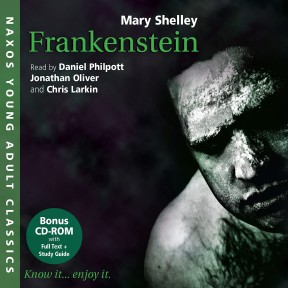
Young Adult Classics – Frankenstein
Read by Daniel Philpott, Jonathan Oliver & Chris Larkin
abridged
One of the greatest classic horror stories, Mary Shelley’s Gothic novel sees Dr Frankenstein manufacture life – The Monster – only to see it go beyond his control. The original novel is more sympathetic to the monster’s plight than is generally presented on film, making it an important book to be read. This abridged version with music is an ideal introduction to teenagers and forms part of the ‘Young Adult Classics’ series launched by Naxos AudioBooks in 2009: each title contains a CD-ROM with extensive ‘teacher notes’ and the full text of the audiobook.
-
2 CDs
Running Time: 2 h 38 m
More product details
ISBN: 978-962-634-965-6 Digital ISBN: 978-962-954-855-1 Cat. no.: NA296512 Download size: 38 MB BISAC: YAF009000 Released: April 2009 -
Listen to this title at Audible.com↗Listen to this title at the Naxos Spoken Word Library↗
Due to copyright, this title is not currently available in your region.
You May Also Enjoy

Reviews
Mary Shelley’s original tale is not the horror story it has become. Both the inquisitive scientist, Frankenstein, and his terrifying creation are treated with great compassion. A gripping and chillingly gothic three-voice narration. Comes with CD-ROM study guide.
Rachel Redford, The Observer
Booklet Notes
WHY STUDY LITERATURE?
The famous Greek philosophers Plato (427–347 BC) and Aristotle (384–322 BC) first clashed when answering this age-old question. Plato felt that literature should be banned. He believed that it was a poor copy of the real world and inflamed people to do stupid and wild things in the manner of its heroes. But Plato’s pupil Aristotle argued that far from corrupting our minds literature actually improves us, enabling us to become more moral by making us feel both pity and fear for its central characters.
The argument today remains more or less the same. Literature’s detractors believe it can lead us astray by making us feel sympathy for evil characters, while literature’s defenders take Aristotle’s view that by feeling for fictional characters we become better people, better at empathising and imagining ourselves in different situations.
As a teacher and lover of literature, I take Aristotle’s view: literature takes us to places that we would never otherwise experience. And reading about murderers doesn’t mean we will imitate them; we may actually learn from their grave errors. Literature affords us the chance to live through other people’s tragedies and triumphs, as a result of which we ourselves may emerge wiser, more thoughtful and happier than before.
Francis Gilbert
MARY SHELLEY’S LIFE
1797 Born Mary Wollstonecraft Godwin on 1 August. Her mother, the philosopher and writer Mary Wollstonecraft, died shortly after giving birth. She and her older half-sister Fanny were brought up by her father and given a liberal education.
1814 Met and became involved with the poet Percy Bysshe Shelley, who was already married. Travelled in Europe with him (and her stepsister Claire Clairmont) and became pregnant. Their prematurely born daughter died.
1816 Married Shelley after his first wife committed suicide.
1816 The Shelleys spent the summer in Switzerland with Lord Byron, Claire and others. In this intense atmosphere, the concept for her most famous novel, Frankenstein, emerged in Mary’s imagination.
1817 What began as an idea for a short story was expanded into a full novel.
1818 Frankenstein: or, The Modern Prometheus was published anonymously on 1 January.
1818 Moved to Italy. Two children were born and died.
1819 Birth of a son, Percy Florence.
1822 Percy Bysshe Shelley was drowned in a storm on 8 July.
1822 Mary returned to England and began to write professionally.
1823 Second edition of Frankenstein appeared, naming Mary Shelley
as the author.
1823 Valperga, her first historical novel was published. It is based on the life of the 14th-century Tuscan despot Castruccio Castracani and a fictional encounter with Countess Euthanasia.
1826 The Last Man, a science fiction novel based in a future world, published. Savaged by critics.
1830 Perkin Warbeck, an historical novel based on the historical character, published.
1835 Lodore, a novel which gives women a central place in the
story, published.
1837 Falkner, a novel which again looks at the role of women
in society, published.
1838 Edited Poetical Works, a collection of the poetry of Percy Bysshe Shelley. She was paid £500.
1839 Began to suffer from ill-health which interrupted her writing.
1848 Moved to live with her son Percy and his wife Jane in Sussex at the Shelleys’ home.
1851 Died on 1 February and was buried in St Peter’s, Bournemouth.