Audio Sample
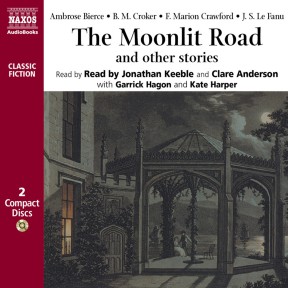
The Moonlit Road
and other chilling stories
Read by Jonathan Keeble & Clare Anderson
selections
These five chilling nineteenth-century ghost stories from both sides of the Atlantic include some of the best in the genre. Bierce is well-known, but To Let by B. M. Croker and The Upper Berth provide moments to tingle the spine, as does An Account of Some Strange Disturbances by Le Fanu. This collection, which is further enhanced by suitably chilling music, was originally released under the title Classic Chilling Tales III.
-
2 CDs
Running Time: 2 h 26 m
More product details
ISBN: 978-962-634-494-1 Digital ISBN: 978-962-954-581-9 Cat. no.: NA249412 Download size: 36 MB BISAC: FIC004000 Released: November 2007 -
Listen to this title at Audible.com↗Buy on CD at Downpour.com↗Listen to this title at the Naxos Spoken Word Library↗
Due to copyright, this title is not currently available in your region.
You May Also Enjoy
Included in this title
- An Account of Some Strange Disturbances in Aungier Street
- That Damned Thing
- The Moonlit Road
- The Upper Berth
- To Let
Booklet Notes
The ghost story came of age in the mid-nineteenth century when large numbers were churned-out for the magazine market, in much the same way as detective stories. As with the detective story, the sheer quantity meant that the quality was rather variable but also ensured the rapid evolution of the form. To work well a good ghost story has to have real characters and believable situations, only then will the introduction of the supernatural element achieve its full impact. Nothing falls flatter than a failed ghost story and failure usually results from the author concentrating so hard on the horror that construction of a satisfactory base on which to build is neglected.
No such problems here. These stories date from the mid- to late-nineteenth century and therefore show the form in its full flood. Their styles may vary but none of them rush the important task of building a stage before allowing a ghost to walk upon it. To Let by Bithia Mary Croker dates from the 1890s and in addition to being a rather effective frightener also offers an insight into Anglo-Indian manners of the time. It is the setting and the feeling for detail which save the tale from becoming commonplace and which divert one’s attention from some rather stilted dialogue. The description of the lights below the veranda is particularly effective. The Upper Berth by F. Marion Crawford is a well-known story, betterknown than its author. Particularly effective is the contrast between the opening of the story, a cosy, sociable evening during which a participant begins to recount an uncanny experience, and the sheer horror of the events he goes on to describe. Though Crawford was writing before M. R. James, this contrast was a tool that James managed to bring to perfection in his work. Joseph Sheridan Le Fanu was, like so many excellent writers of English, born in Dublin. Intelligent and cultured like their author, his stories are among the very best of their type and I would rate An Account of Some Strange Disturbances in Aungier Street as perhaps his most effective; the title alone is enough to produce a thrill of anticipation. I read this story when I was eleven and suffered a sleepless night as a result. The stories described so far emerged from the educated, comfortable middle rank of English society, and largely reflected a world of scholarly pursuits, the Empire, the Church. The final two stories, and their author, are very different.
Ambrose Bierce was born in Ohio in 1842 into a family with a tendency towards eccentricity (a brother ran away with the circus, a sister was allegedly consumed by cannibals). After a courageous time in the Civil War he became a successful and feared journalist on the West Coast; by all accounts he also became a thoroughly cantankerous and unpleasant individual. His end, in 1913, was as strange as his life. He went to Mexico and disappeared completely. Bierce’s ghost stories are not among the best-written but they are unusual and distinctly ‘modern’ in their definition of what constitutes a ‘ghost’. They enjoy a popularity today that eluded them during Bierce’s lifetime, perhaps because the late twentieth century reader is more prepared to accept his psychological approach to the genre. The stories resist neat classification, no conclusions are offered. Whatever the true nature of the entity in The Damned Thing, Bierce offers no tidy answer. One of the protagonists offers his theory but it is no more than that and you are left with the feeling that perhaps the entity wanders the earth to this day and that Bierce merely recorded one episode of its existence.
The Moonlit Road offers an approach to the supernatural that must have seemed entirely new when it was written. The emotion we are left with at the end is not horror or fear but despair, a despair that will not disperse when the cock crows. Bierce deserves his reputation for being one of the first to take the ghost story out of the Victorian country house and base it in the human psyche. The twentieth century ghost story was to develop very differently after his example.
No such problems here. These stories date from the mid- to late-nineteenth century and therefore show the form in its full flood. Their styles may vary but none of them rush the important task of building a stage before allowing a ghost to walk upon it. To Let by Bithia Mary Croker dates from the 1890s and in addition to being a rather effective frightener also offers an insight into Anglo-Indian manners of the time. It is the setting and the feeling for detail which save the tale from becoming commonplace and which divert one’s attention from some rather stilted dialogue. The description of the lights below the veranda is particularly effective. The Upper Berth by F. Marion Crawford is a well-known story, betterknown than its author. Particularly effective is the contrast between the opening of the story, a cosy, sociable evening during which a participant begins to recount an uncanny experience, and the sheer horror of the events he goes on to describe. Though Crawford was writing before M. R. James, this contrast was a tool that James managed to bring to perfection in his work. Joseph Sheridan Le Fanu was, like so many excellent writers of English, born in Dublin. Intelligent and cultured like their author, his stories are among the very best of their type and I would rate An Account of Some Strange Disturbances in Aungier Street as perhaps his most effective; the title alone is enough to produce a thrill of anticipation. I read this story when I was eleven and suffered a sleepless night as a result. The stories described so far emerged from the educated, comfortable middle rank of English society, and largely reflected a world of scholarly pursuits, the Empire, the Church. The final two stories, and their author, are very different.
Ambrose Bierce was born in Ohio in 1842 into a family with a tendency towards eccentricity (a brother ran away with the circus, a sister was allegedly consumed by cannibals). After a courageous time in the Civil War he became a successful and feared journalist on the West Coast; by all accounts he also became a thoroughly cantankerous and unpleasant individual. His end, in 1913, was as strange as his life. He went to Mexico and disappeared completely. Bierce’s ghost stories are not among the best-written but they are unusual and distinctly ‘modern’ in their definition of what constitutes a ‘ghost’. They enjoy a popularity today that eluded them during Bierce’s lifetime, perhaps because the late twentieth century reader is more prepared to accept his psychological approach to the genre. The stories resist neat classification, no conclusions are offered. Whatever the true nature of the entity in The Damned Thing, Bierce offers no tidy answer. One of the protagonists offers his theory but it is no more than that and you are left with the feeling that perhaps the entity wanders the earth to this day and that Bierce merely recorded one episode of its existence.
The Moonlit Road offers an approach to the supernatural that must have seemed entirely new when it was written. The emotion we are left with at the end is not horror or fear but despair, a despair that will not disperse when the cock crows. Bierce deserves his reputation for being one of the first to take the ghost story out of the Victorian country house and base it in the human psyche. The twentieth century ghost story was to develop very differently after his example.